After decades of loss, one kind of forest is making a comeback. It is not the forest that ends up in pallets or crates, and that is worth saying up front. Mangroves are coastal trees that grow in salt water, and a new global study says they have been expanding again since about 2010.
NASA Earth Observatory featured the findings on November 13 as its Image of the Day, “A Global Rebound for Mangroves.” The underlying paper, led by Zhen Zhang of Tulane University, was published in Science in June.
Here’s what the satellites show, why it matters, and what it does not mean for wood packaging.
What the satellites show
Scientists have used satellites to map mangrove forests since the 1970s. For a long time, the maps told a story of decline. Zhang’s team built what he describes as the first global mangrove maps to cover such a long stretch of time, using Landsat imagery collected from 1984 to 2023.
They tallied losses of nearly 3,000 square kilometers (1,200 square miles) between 1984 and 2010, then an unexpected increase of nearly 2,000 square kilometers (770 square miles) after 2010. The rebound was led by expansion in Asia, Australia, and South America. Many of today’s mangrove forests also have denser, more closed canopies than they did in 2010, which the researchers treat as a sign of healthier, less degraded forests, especially in South America.
The Science paper puts the long-term change in perspective: global mangrove extent shifted from net loss to net gain around 2010 and changed only marginally from the 1980s to 2023, by −0.5% ± 1.4%.
About two-thirds of the expansion came from mangroves colonizing new areas, Zhang said, and the other third from restoration and regrowth in degraded areas.
A turnaround in some places, continued losses in others
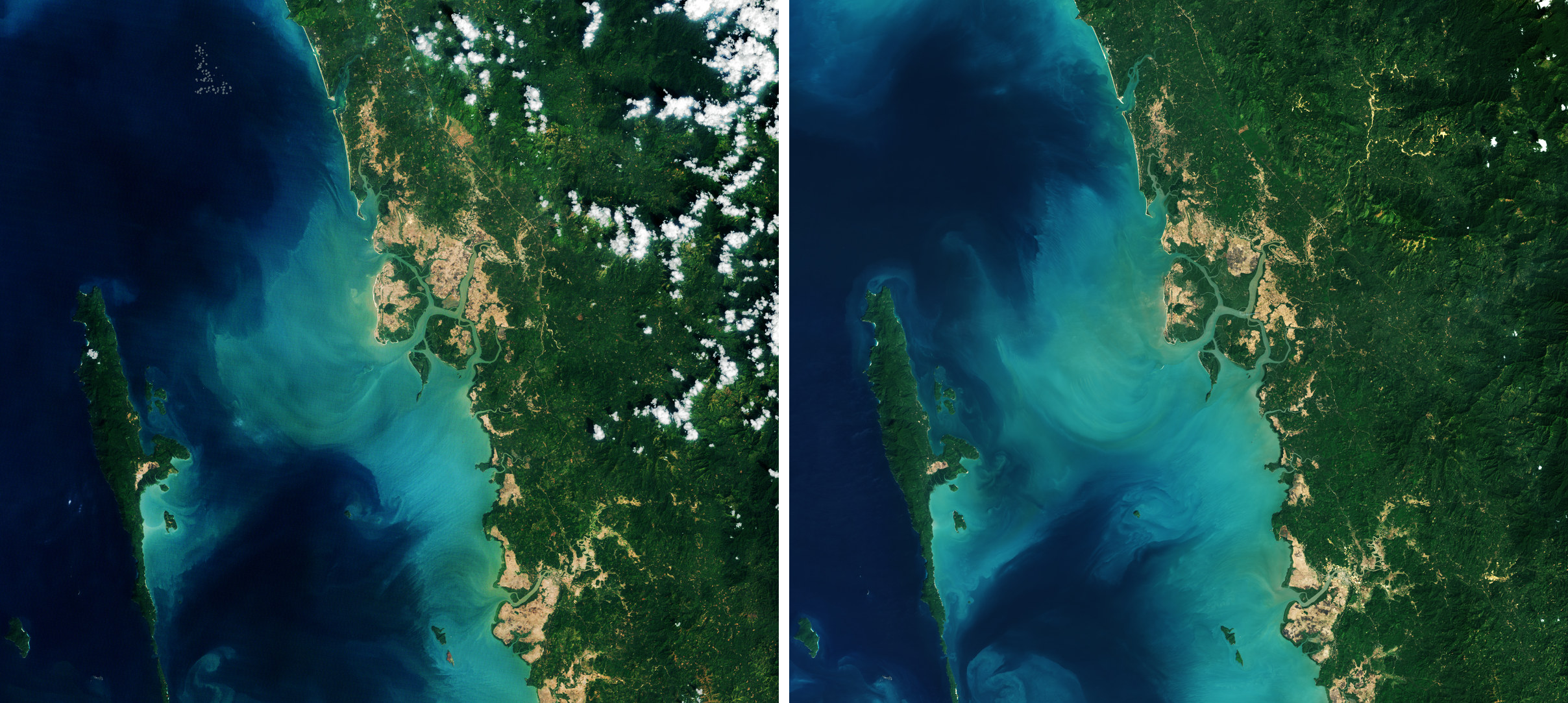
One of the clearest reversals was in Southeast Asia, especially Burma (Myanmar). The country lost mangroves rapidly in the 1980s and 1990s as agriculture, aquaculture, and firewood harvesting expanded along the coast. The trend reversed around 2010. The authors point to restoration efforts and greater awareness after the 2004 Indian Ocean tsunami, stronger legal protections for forests, and new mudflats created by sediment, which mangroves could colonize.
Despite those gains, deforestation is still a problem there. Burma lost 28.6% of its mangrove area between the 1980s and 2010. Since then, the country’s mangrove area has grown about 10%.
NASA’s before-and-after Landsat images show the change in Palaw Township in Burma’s Myeik District, comparing February 14, 2010, with February 2, 2026. In that area, much of the regeneration appears to be occurring in abandoned rice fields.
The same pattern of new mudflats helping mangroves spread shows up around the mouth of the Amazon River and in northern Australia, where the forests have increased steadily since the 1990s. At the edges of their range, including the southeastern United States, warming temperatures and fewer freezes have also allowed mangroves to move into areas that used to be too cold.
The rebound is not universal. Substantial losses in the Niger Delta have reduced the total mangrove area in West and Central Africa since 2010. North America and southern Africa have seen widespread degradation after tropical cyclones. “The global successes we’ve seen with mangroves during the past decade should not be seen as grounds for complacency,” Zhang cautioned. The paper also notes that newly established stands need time to store carbon and recover the functions of the forests they replaced. Slowing deforestation, the authors argue, is still the priority.
Why mangroves matter — and what they are not
Mangrove trees are relatively small, averaging about 13 meters (43 feet). Their ecosystems, NASA reports, store up to four times as much carbon as taller inland tropical forests. The trees help protect coastal communities from erosion and storm surges, and their stilt-like roots serve as habitat and nursery grounds for fish, shrimp, crabs, and other marine life.
They are not a source of the lumber used in pallets, crates, or dunnage. Nothing in this research changes what goes into a wood package, or what it costs.
It is still a forest story worth paying attention to. Wood packaging comes from forests, and the basic lesson here is a hopeful one: when pressure eases and protection is in place, forests can come back. That is the same idea behind the tropical forest fund we wrote about and the Amazon deforestation record we covered in October. Progress is real, and it is also fragile.
The most reliable way to shrink the forest footprint of packaging is still to use less wood: right-sized pallets, lighter crate designs, and reusable packaging where it fits. Our PackTrim program is built around finding those savings.
What we do through Rainforest Trust
Mangrove recovery is not something Wisconsin Lumber & Pallet can take credit for. We do support forest conservation, and we do it through Rainforest Trust, the primary beneficiary of our 1-2-3 Conservation Program.
We donate 1% of our sales to global forest conservation programs. When a customer donates up to 1% of their spend to the same charities, we match it. Together, that means up to 3% of packaging spend can go toward protecting forests. Archangel Ancient Tree Archive is a secondary beneficiary of the program.
Our focus is on rainforests being cleared for palm oil and cattle, and on places where rainforest timber is being cut illegally. That is the inland tropical forest work our support is aimed at.
Rainforest Trust also protects mangrove forests. Its mangrove conservation page describes work with local partners in Mozambique, Costa Rica, Cameroon, and elsewhere. In April 2024, Rainforest Trust reported that it and its partner RARE Brazil had completed the protection of mangrove reserves in Brazil’s Amazon estuary. It also has a project in the Philippines to protect coral reefs and mangrove forests around Southern Palawan, and work in Cameroon to expand protection of coastal forest, mangrove, and marine habitat. We are not claiming that our donations paid for those mangrove projects. It is part of what our primary charity partner does, alongside the rainforest work that is the focus of our support.
Less Waste. More Trees.
Quick answers
Are mangrove forests still shrinking? Not at the global level, according to a 2026 Science study of Landsat images from 1984 to 2023. Researchers tallied losses of nearly 3,000 square kilometers between 1984 and 2010, then an increase of nearly 2,000 square kilometers after 2010, led by Asia, Australia, and South America. The paper finds that global mangrove extent shifted from net loss to net gain around 2010 and changed only marginally from the 1980s to 2023.
What is driving the rebound? About two-thirds of the expansion came from mangroves colonizing new areas, such as mudflats created by sediment, and about one-third from restoration and regrowth in degraded areas, according to lead author Zhen Zhang of Tulane University. In Burma (Myanmar), the authors also point to restoration after the 2004 Indian Ocean tsunami and stronger legal protections. The rebound is not universal: losses have continued in places such as the Niger Delta, and storms have degraded mangroves in North America and southern Africa.
Do mangroves have anything to do with pallets or crates? No. Mangroves are coastal trees that grow in salt water. They are not a source of the lumber used in pallets, crates, or dunnage, and this research does not change what goes into a wood package or what it costs.
Does Rainforest Trust work on mangroves, and how does Wisconsin Lumber & Pallet support it? Yes. Rainforest Trust and its local partners protect mangrove forests in several countries, including completed mangrove reserves in Brazil’s Amazon estuary and projects that include mangroves in the Philippines and Cameroon, according to Rainforest Trust. Wisconsin Lumber & Pallet supports Rainforest Trust as the primary beneficiary of our 1-2-3 Conservation Program: we donate 1% of our sales, and we match customer donations of up to 1% of their spend. Our own focus is on rainforests being cleared for palm oil and cattle, and on illegal cutting of rainforest timber. We do not claim that our donations funded those mangrove projects.
Why are we writing about them? Because wood packaging comes from forests, and this is a credible account of forests coming back when pressure eases and protection is in place. The most reliable way to shrink the forest footprint of your packaging is still to use less wood. Programs that pay to keep forests standing, including our 1-2-3 Conservation Program, come from the same idea.
If you’d like to look at whether your pallets and crates could use less wood without giving up strength, contact us or call 414-520-3366 for a free packaging review.
Sources
NASA Earth Observatory, “A Global Rebound for Mangroves,” Image of the Day, Nov. 13, 2026: https://science.nasa.gov/earth/earth-observatory/a-global-rebound-for-mangroves/
Zhang, Z., et al. (2026). Unexpected expansion and regrowth in Earth’s mangrove forests over the past four decades. Science, 392(6802), 1082–1087. Published June 4, 2026: https://www.science.org/doi/10.1126/science.aec9773
Tulane University, “Global mangrove forests rebound, offering hopeful sign for climate and coastal resilience,” June 4, 2026: https://news.tulane.edu/pr/global-mangrove-forests-rebound-offering-hopeful-sign-climate-and-coastal-resilience
Rainforest Trust, mangrove conservation overview: https://www.rainforesttrust.org/our-impact/global-scope/mangroves/
Rainforest Trust, “Good News for Conservation in Brazil!,” April 3, 2024: https://www.rainforesttrust.org/our-impact/rainforest-news/good-news-for-conservation-in-brazil/
Rainforest Trust, “Stop Unsustainable Fishing in Philippine Coral Reefs and Mangrove Forests”: https://www.rainforesttrust.org/urgent-projects/stop-unsustainable-fishing-in-philippine-coral-reefs-and-mangrove-forests/
Rainforest Trust, “Greater Protection for Cameroon’s Atlantic Rainforest”: https://www.rainforesttrust.org/urgent-projects/greater-protection-for-cameroons-atlantic-rainforest/
Wisconsin Lumber & Pallet, 1-2-3 Conservation Program: https://wisconsinlumber.com/1-2-3-conservation-program/
Wisconsin Lumber & Pallet, “A Fund That Pays to Keep Forests Standing Nears $8 Billion,” Nov. 18, 2026: https://wisconsinlumber.com/tropical-forest-fund-cop31/
Wisconsin Lumber & Pallet, Amazon deforestation record (October 2026): https://wisconsinlumber.com/amazon-deforestation-record-low-what-it-means/
Seymour Lumberton, Wisconsin Lumber & Pallet